Showing posts with label windows-phone7. Show all posts

Introducing the OMG Techies ! Windows Phone 7 app

Omgtechies

Now you can get the latest tech news ranging from devices like iPhone to Linux wherever you are on your Windows Phone 7.

1 of 3 
Download
It’s available for no charge in the Windows Phone Market.
3 of 3 


Application Development: Nokia Woos Developers With Windows Phone Strategy


Microsoft and Nokia are combining their developer muscle to target developers for Windows Phone.
At the second day of the Nokia World conference in London, representatives from the two companies said they will be providing 25,000 free Nokia Lumia 800 Windows Phones to developers who are committed to writing apps for the platform. The give-away begins October 27, officials said — starting with a truck full of phones right outside the Excel Convention Center, the venue for this week’s Nokia World 2011 show.
The message from the pair during a developer track at the show was that “1+1=3″ — the combination of Microsoft and Nokia can achieve more than either could individually. Nokia’s retail and merchandising savvy; its localization know-how in Europe, Asia and Africa; and its strong relationships with operators (especially in the area of mobile billing) will benefit Microsoft and the entire Windows Phone ecosystem, the two contended. Microsoft’s established developer tools; its cloud infrastructure; and its operating system expertise will aid Nokia and its developers as the Finnish company attempts to set itself on a new course, Nokia and Microsoft officials said.
Microsoft and Nokia also said they plan to host 1,000 joint events — code camps, hackathons, and other kinds of hands-on confabs — over the next year as part of their “Smarter Way to App” campaign. They are aiming to reach out to 100,000 developers between now and June.

Bencke's slide on the new ecosystem points to the work that needs to be done.


Bencke's slide lays out the foundation of the Windows Phone opportunity for developers.


Source - [ eweek.com & zdnet.com ]

Windows Mango Matches Apple and Android in Features: But for How Long?


By Daniel Ionescu

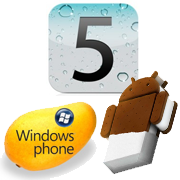
Microsoft's Windows Phone Mango brings the mobile OS up to snuff with Apple's iOS and Google's Android OS. But Microsoft will soon find itself behind the eight ball again compared to what Apple has in store with iOS 5 and Google with Android Ice Cream Sandwich, both of which are set launch later this fall.
The most trumpeted feature of Mango is multitasking, something that rival operating systems have already mastered (admittedly, some later than others). Other Mango improvements include new conversation threads, which combine text, IM and Facebook chat; a revamped Web browser that Microsoft says will be much faster than other mobile browsers; and better support for HTML5 (no Flash support announced).
Apple Seeks Android Inspiration
Meanwhile, Apple has played catch-up with Google's Android in iOS 5, set to become available to consumers this September. With iOS 5, Apple finally adds a notifications center (similar to Android's), as well as contextual Twitter (but not Facebook) integration and Mail and Safari improvements.
Apple has already stolen the spotlight with iOS 5, announcing a PC-free iPhone, and iPad (meaning you won't need a computer cable to activate, sync, or update apps and media), iMessage (like BBIM for iOS devices), and cloud integration via iCloud.
Android Has Its Own Problems
Google has its own catching up to do too with Android, especially when it comes to fragmentation, which is one of the biggest annoyances of the platform. Unlike Apple customers, who get a software update as soon as the company pushes it out, Android updates are trickled through to manufacturers and wireless carriers (who are also the distributors), and take significantly longer to reach customers.
This has created what is called fragmentation: only a minority of users is running the latest software, while others are stuck waiting for software updates that may not even show. Given the variety of the Android ecosystem, developers also have to work on many screen sizes, resolutions and hardware capabilities, making the Android development process more difficult than on Apple's relatively unified platform.
Google hopes to solve the problem of fragmenting its OS with Ice Cream Sandwich, which is set to arrive in Q4. The update plans to make it easier for developers to create apps for the various Android hardware and software versions, but Google has not detailed on how it plans to achieve that. Ice Cream Sandwich also promises to level the differences between the phone-based (Gingerbread) and tablet-based (Honeycomb) versions of the OS.
Is Apple Winning?
Overall though, there are indications that the iPhone 5 and iOS 5 have already won the hearts of consumers shopping for a smartphone this fall. A survey from comparison site PriceGrabber found that Apple's "anticipation and brand loyalty are certainly high", with 48 percent of respondents saying they prefer iOS, compared to 19 percent choosing Android and only 7 percent going for Microsoft's Windows Phone 7 platform.
While Microsoft and partner manufacturers and carriers are taking their sweet time to push Mango (announced in April, heading to phones some time in September), Microsoft has its work cut out for it if it wants to compete against Apple.
Yet the upcoming features of Mango, which was released to manufacturers on Wednesday, bring little novelty to the smartphone arena dominated by Google and Apple. Microsoft needs to do more than just play catch-up with Apple and Google, who always seem to be one step ahead of the game.
Does Microsoft stand any chance against Apple and Google with its smartphones? Will you buy an iPhone, Android or Windows Mango Phone this fall? Sound off in the comments.

Source - [ pcworld ] 

Windows Phone Success Depends On Apps


The new wireless platform from Microsoft has gone from zero apps last fall to over 20,000 today. That is still well below what you can find in Apple's App Store or Google's Android Market, but it is nothing to sneeze at. In fact, the rapid rise of apps may have been a factor in Nokia's decision to dump the MeeGo platform and hitch its wagon to Microsoft.
No one would argue that HP's webOS isn't a competent platform, but it is struggling. This is partly because for over six months it was exclusive to the Sprint network, the third place network in the US. The other reason, though, is the store for webOS apps is languishing. The last official count I could find was 5,000 by the end of September, 2010. That is fifteen months after the platform launched.
Microsoft has collected four times that amount in less than half the time. It is still missing a lot of apps from a number of key players. While Bank of America has an app for Windows Phone, Citi, Chase, Schwab, ING Direct, and Wells Fargo do not. They all have apps for the iPhone and Android devices though. The tale is similar across major apps like Dropbox, X-Marks, and others. When sites like Lifehacker post an article on how to save money with smartphone apps, all or most are available for iOS and Android, but few if any are on Windows Phone yet.
Still, 20,000 is a good start. But the platform has a long way to go. Amassing over 2,000 each month may have been enough to tip the scales in favor of Windows Phone over MeeGo. Nokia's Ovi store would need to start largely at ground zero. That is a tough sell. The days of people buying a smartphone for the operating system are over, platform fan boys notwithstanding.
Consumers want apps. They want to access their bank information, find local deals, access social networks, play games, etc. Starting a new platform today is a risky proposition, because consumers want a phone with apps, and developers want a platform with consumers. It is the classic chicken or egg scenario. Microsoft jump-started its platform by writing a healthy amount of its own apps, mostly in the way of games, and by reaching out to the developer community, something they know how to do.


It is doubtful Nokia could have pulled the same stunt off.
Windows Phone hasn't really pulled it off yet either. It is still early, but the momentum is definitely headed in the right direction. 

Source - [ informationweek ]

Why Nokia picked Microsoft: Windows Phone 7's 20,000 apps and counting

That number might not seem like much compared to the gazillion apps at Android Market or Apple's App Store, but those 20,000 apps answer a question on many techies' lips this week: Why didn't Nokia pick MeeGo? Windows Phone Marketplace passed the 20k threshold about a month ago.


Windows Phone logo street


The N9's unexpected launch on June 21 was one of the most perplexing mobile phone announcements in recent memory. The N9 is a stunning piece of hardware that runs smart-looking software -- MeeGo 1.2. But Nokia has all but abandoned MeeGo and Symbian, which despite market share declines is still the most widely used mobile operating system on the planet. The N9 had lots of gawkers drooling over its sexiness but disappointed that with MeeGo there's no point.
MeeGo was supposed to be Nokia's future before CEO, and former Microsoft divisional president, Stephen Elop cut the Windows Phone distribution deal earlier this year. Instead of a slow transition from Symbian to MeeGo, Nokia would fast-track to Microsoft's mobile OS.
Nokia's other MeeGo phone is the N900, and the selection of apps is meager at best. The company's Ovi Store, serves up 90-top free apps, 88 bestsellers and 166 new ones for N900, with the latter category actually looking like the entire selection available. By comparison, the number of apps available for Windows Phone is simply enormous. Microsoft has developers, and they're working the apps. Remember, that Windows Phone only became available in autumn with about 1,000. Less than two months ago, the number was 18,000. It was 20k in late May. Who knows, 25,000 may be close coming.
I used to own a N900. It was a brick, but I still loved the smartphone. It had real character, and MeeGo was a major reason why. There was something quite different about using the N900 compared to iPhone or any Android handset. The N900 felt more like a pocket computer, and MeeGo provided dramatic capabilities. I still miss N900.
But platforms need applications. Either the phone's manufacturer provides them or third-parties do -- and ideally both. MeeGo doesn't have much from either. Nokia is really good at doing hardware but long hasn't been able to compete on software and services. From that perspective, the Microsoft marriage has potential.
The questions now: How long before there are 25,000 apps, and what will the number be when the first Nokia Windows Phone ships. Earlier this week, Elop quietly showed off the first prototype -- "Sea Ray" -- and of course it leaked out right away.
Microsoft doesn't need hundreds of thousands of apps for Windows Phone to succeed. The platform just needs enough of them. Which ones is more important than how many. Still, larger number has marketing value for both potential customers and developers.
That said, compared to Android Market and App Store, 20,000 doesn't seem like much. They offer more than 200,000 and App Store 450,000 apps, respectively.

Source - [ betanews ]
Related Posts Plugin for WordPress, Blogger...